Minimax 2.5 is MUCH better and I can PROVE it
Summary
In this video, you get a practical look at why Minimax 2.5 is a meaningful upgrade over its predecessor, using a deceptively simple real-world test to prove it. The test: should you walk or drive to the car wash? The answer is obvious to any human — you need your car there — but it trips up several AI models. Minimax 2.1 and Deepseek both suggest walking, while Minimax 2.5 and Kimi correctly say you should drive. This simple logical consistency test is presented as a more honest benchmark than official leaderboards, especially if you plan to use these models in agentic workflows where small reasoning failures can cascade into bigger problems. You also get a peek at a multi-agent Discord setup where an Opus-powered agent named Stark orchestrates smaller agents, including Minimax 2.5, for lower-stakes coding tasks. This layered approach lets you get roughly 95% of Opus-level results at a fraction of the cost. The cost comparison is stark: Minimax 2.5 outputs tokens at $1.20 per million, while Opus runs at $75 per million. For general coding and agentic tasks, Minimax 2.5 handles the load well. Opus is reserved for complex, mission-critical work. A coding plan for Minimax is also mentioned, offering 300 prompts every five hours for around $20, making it a cost-effective option for heavy agent use. One honest caveat: even Minimax 2.5 occasionally gave the wrong answer on the car wash test during repeated runs, which is a fair reminder that no model is perfect right now. The broader takeaway is that simple, common-sense reasoning tests are a practical way to evaluate whether a model is ready for real-world agentic use — and right now, Minimax 2.5 clears that bar more reliably than its older version.
Related Videos
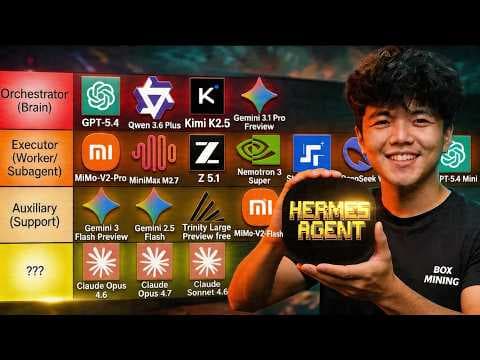
Top AI Models for Hermes Agent (Tier List)

Opus 4.7 is disappointing

Anthropic releasing Opus 4.7 TOMORROW?

Claude Opus is ACTUALLY UNUSABLE

Muse Spark: Meta Unleashes NEW AI Model (Are they back?)